01 / 15
HEAT· ALCBT MRV TOOL
User Guide · 2026

The ALCBT MRV Tool turns embodied building carbon into a decision you can act on

An interactive Monitoring, Reporting & Verification platform for the upfront A1–A3 carbon locked into new buildings across five Asian economies — built for policymakers, NDC teams and programme partners.

alcbt-dashboard.pages.dev
HEAT GmbHMRV tool developer
Königstein, Germany
2025 → 2070Projection horizon
5 countriesIndia · Indonesia · Cambodia · Thailand · Vietnam
Funded byBMUKN via the International Climate Initiative (IKI)
Why This Tool Exists

Asia's building boom is locking in carbon faster than policy can measure it — the MRV Tool closes that gap

Situation

The fastest-growing building stock on Earth

The five ALCBT countries are urbanising at record pace. Every new building locks in upfront A1–A3 carbon the day it goes up.

20–25%of lifecycle is embodied
Complication

Embodied carbon is invisible to policy

The A1–A3 carbon in concrete and steel is largely unregulated, unmeasured — and impossible to retrofit away once built.

~10%of global emissions
Resolution

One free, transparent decision platform

The MRV Tool models embodied A1–A3 carbon across materials, three scenarios and 46 years — so policymakers can test what cuts it.

Freeopen & web-based
What It Is

A web-based decision-support tool that models embodied building carbon the way governments need to report it

No installation, no license. Open the dashboard, choose your jurisdiction, and read embodied A1–A3 carbon pathways grounded in RICS, GCCA, LESS and IEA data.

A1–A3

product-stage scope — cement, steel, concrete & more

3

scenarios — BAU, Energy Efficiency & Net Zero

5

countries with comparable, harmonised baselines

The Core Insight

Embodied carbon is locked in the day a building goes up — and no future fix can undo it

The A1–A3 footprint of concrete and steel is emitted before the building is even occupied. It cannot be retrofitted or decarbonised later — which makes the choice of materials, today, the decisive lever. The tool makes that locked-in carbon visible and shows where to cut it.

~10%

of global energy-related emissions are embodied (A1–A3)

20–25%

of a building's lifecycle carbon is embodied

50 yr

lifetime over which upfront carbon is annualised

3

material levers modelled: cement, steel, concrete

The question is no longer whether to act — it is which material, in which country, in which decade. This tool answers that.

Who Benefits — And How

Every actor in the embodied-carbon chain gets a specific, ready-to-use answer

Government policymakers

Ministries of Environment & Housing · Building code authorities

Test how material standards and green-procurement rules bend the embodied-carbon curve before committing to them.

NDC & MRV teams

UNFCCC focal points · GHG inventory units

Get a consistent A1–A3 scope and documented assumptions for credible embodied-carbon emission-reduction accounting.

Finance & investment actors

Green banks · Development finance · Programme investors

Quantify the embodied savings that justify the EUR 140M investment target and direct capital to the highest-impact materials.

Programme partners & researchers

GGGI · ACE · EESL · National research institutes

A shared, transparent evidence base for training and the 51 entities targeted to adopt low-carbon-building tools.

What Information It Provides

Five connected views take you from the regional headline to the underlying data

01

Overview

All-country embodied pathway summary — A1–A3 emissions and floor area 2025–2070, with each country's savings potential.

02

Carbon Breakdown

The embodied A1–A3 pathway with interactive material sliders for cement, steel and concrete ambition.

03

Policy & Standards

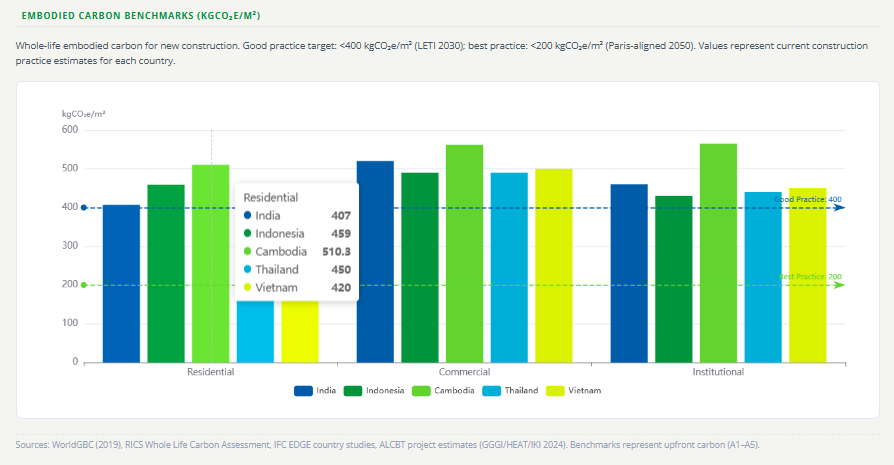
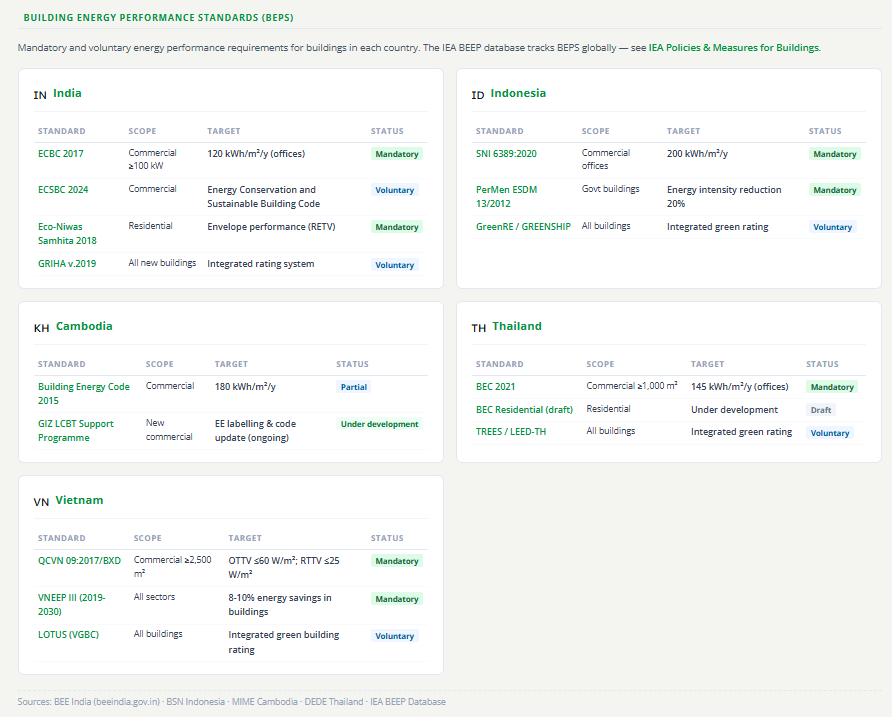
NDC targets, embodied-carbon benchmarks (LETI / RICS) and material-standard roadmaps by country.

05

Partner Ecosystem

The consortium behind the data — IKI (donor, BMUKN) · GGGI (lead) · HEAT (MRV developer) · ACE · EESL — and the programme's 2028 targets.

Tab 01 · Overview

Start with the headline: the size of the prize, country by country

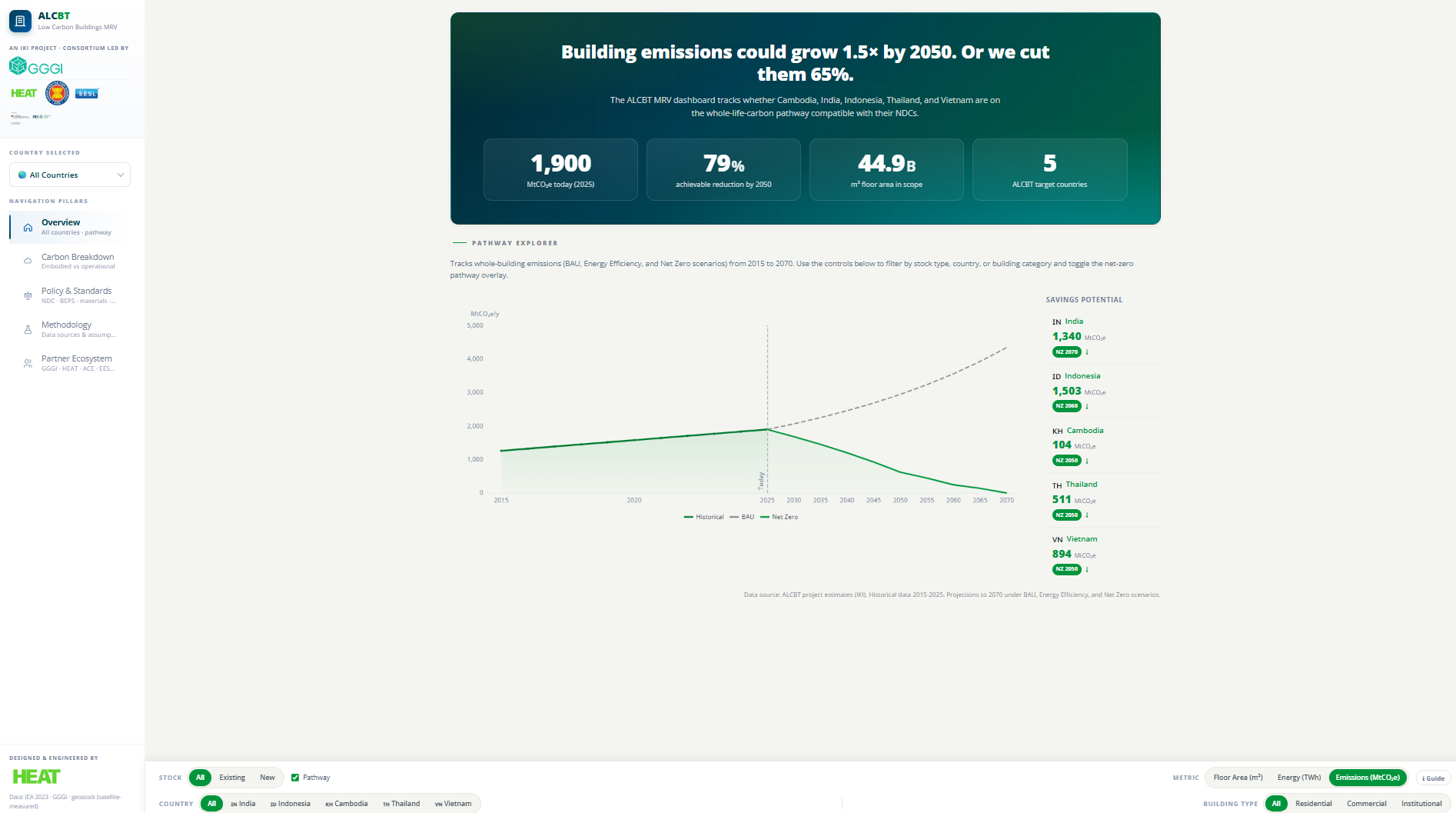
Overview dashboard tab
Overview tab · live dashboardembodied trajectory 2025–2070
What you see

KPI tiles plus the embodied A1–A3 trajectory, with shaded savings potential per country.

How to use it

Filter by country, building type and stock to frame the scale of action.

Setup & inputs

Five harmonised baselines; floor area grows 1.5–2%/yr compound (NITI Aayog · UN DESA).

Tab 02 · Carbon Breakdown

Trace the embodied A1–A3 pathway as the building stock grows

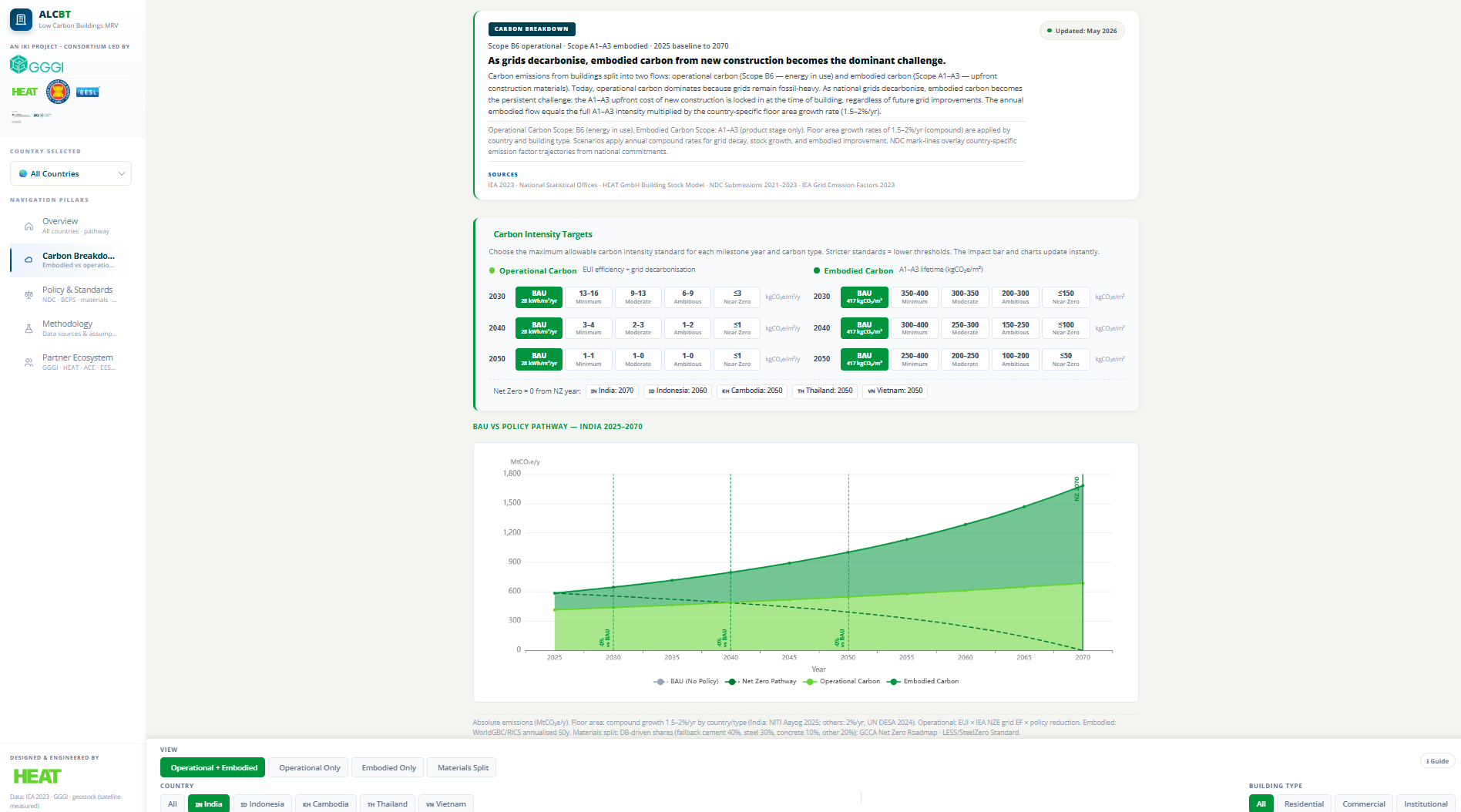
Carbon breakdown tab
Carbon Breakdown tab · live dashboardembodied A1–A3 by scenario
What you see

The embodied A1–A3 pathway by scenario, with a 2025-baseline country comparison.

How to use it

Compare BAU, Energy Efficiency and Net Zero to see how far material policy bends the curve.

Setup & inputs

A1–A3 intensities from RICS, WorldGBC & ALCBT estimates; 50-year annualisation.

Interactive · Material Levers

Move the sliders, and the 2070 embodied pathway recalculates in real time

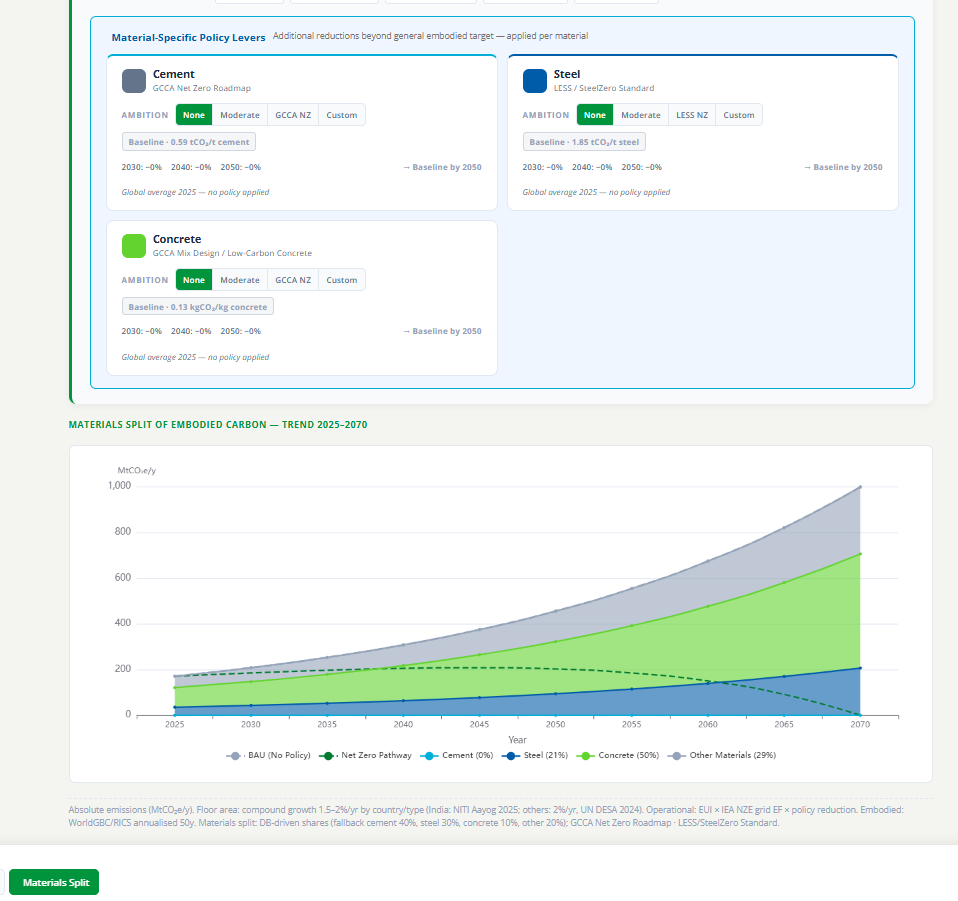
Material policy levers
Material-specific policy leverscement · steel · concrete, GCCA / LESS roadmaps
What you control

Material ambition for cement, steel and concrete at 2030 / 2040 / 2050.

How to use it

Set ambition to None, Moderate, GCCA/LESS Net-Zero or Custom; read the materials-split trend instantly.

Setup & inputs

Baselines: cement 0.59 tCO₂/t · steel 1.85 tCO₂/t · concrete 0.13 kgCO₂/kg.

Tab 03 · Policy & Standards

Every scenario is anchored to real commitments, codes and benchmarks

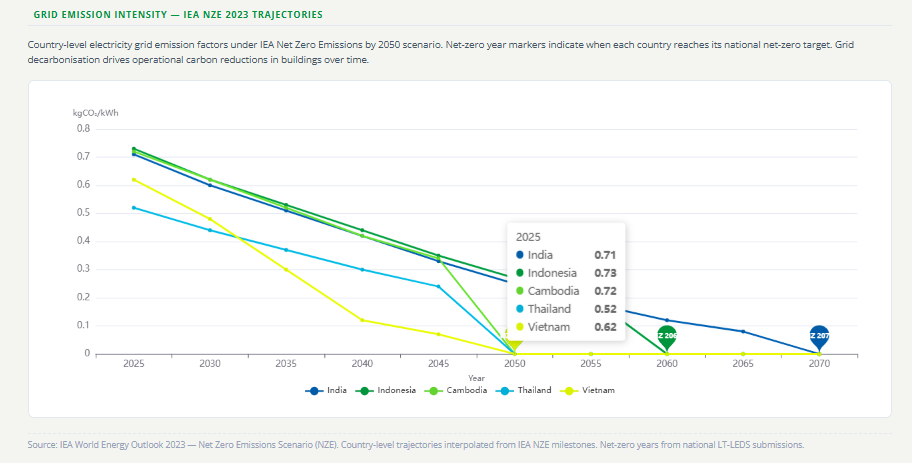
Embodied benchmarks (LETI <400, Paris-aligned <200 kgCO₂e/m²) and GCCA / LESS material roadmaps set the ambition; NDCs and national codes set the context. Sources: UNFCCC NDC Registry · RICS Whole Life Carbon · WorldGBC · IEA WEO 2023.

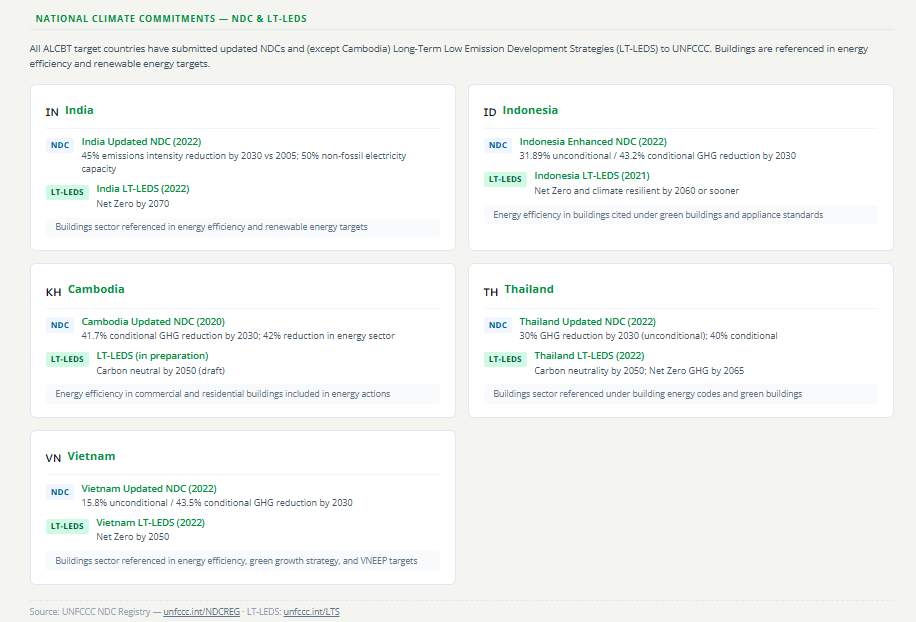
NDC & LT-LEDS commitmentsNDC commitments
Embodied carbon benchmarks · LETI / RICSEmbodied benchmarks
Building energy performance standardsBEPS
Grid decarbonisation · IEA NZEGrid trajectories
Tab 04 · Methodology

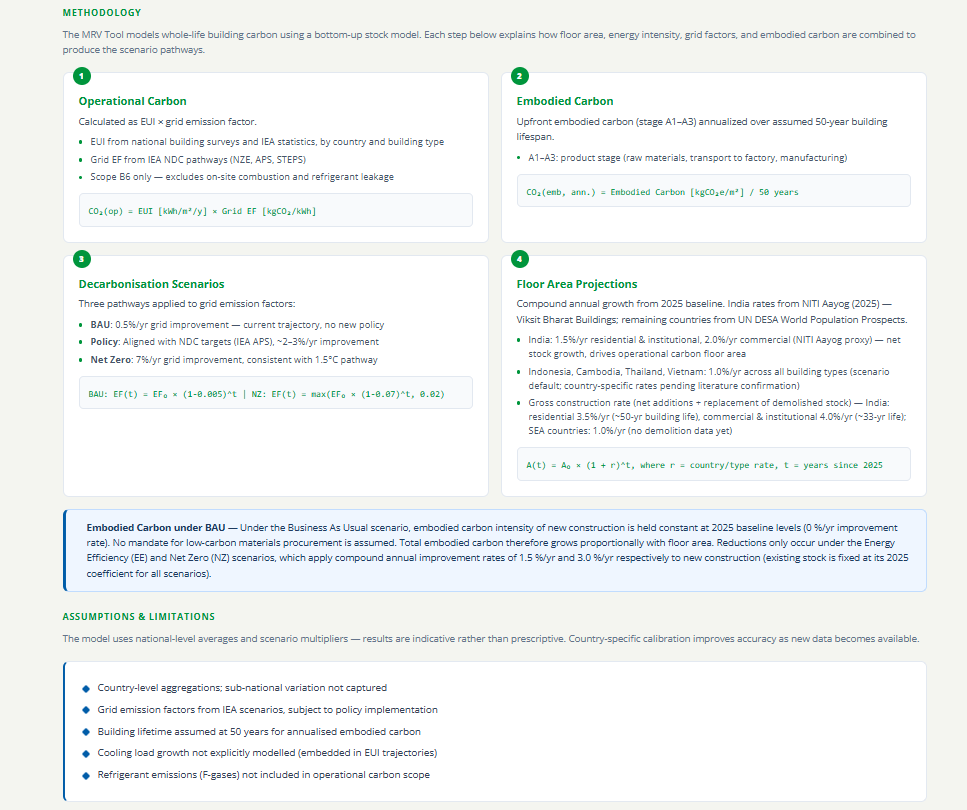
Transparent by design — every number traces back to a formula and a source

Methodology tab
Methodology tab · live dashboardembodied formulas & assumptions
Embodied (A1–A3)

Floor Area × EC intensity × 2% construction rate ÷ 1000 = MtCO₂e/yr.

Annualised over 50 yr

Upfront A1–A3 material carbon spread across a 50-year building lifetime.

Material breakdown

Split by cement, steel, concrete & other — each with its own reduction roadmap.

The Setup · Data Inputs

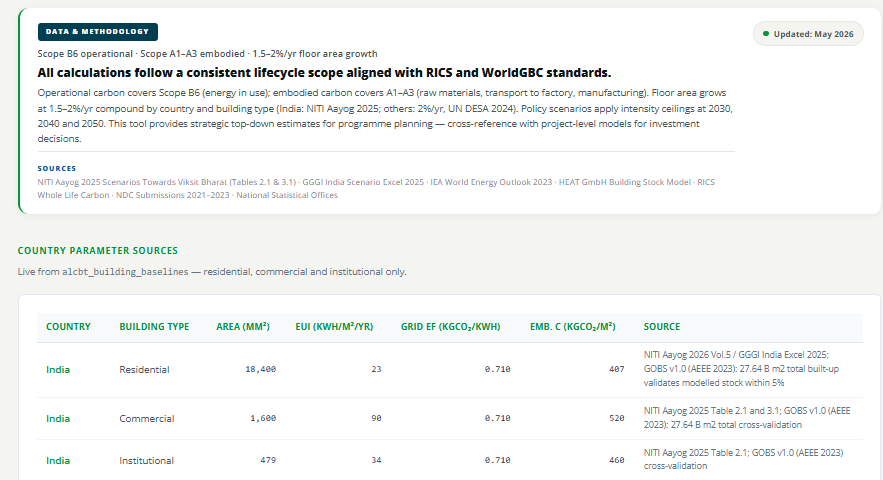
Set up once: the baseline that drives every embodied pathway

Country parameter baselines
Country parameter sources · live dashboardalcbt_building_baselines
What it is

The baseline table — floor area, material intensity and source per country and building type.

How it's built

Live from the ALCBT Building Stock Model; India validated against GOBS v1.0 within 5%.

Sources

NITI Aayog 2025 · GGGI India Scenario 2025 · RICS Whole Life Carbon · UN DESA 2024.

Why it matters

Every scenario and slider inherits these inputs — change the baseline, the whole 2070 pathway updates.

How To Use It — In Five Steps

From landing page to policy evidence in under five minutes

01

Set your scope

Choose Country, Building Type and Stock — focus on your jurisdiction or compare all five ALCBT countries.

02

Pick a metric

Toggle Floor Area or Embodied Emissions (MtCO₂e) to match your reporting framework.

03

Compare scenarios

Read BAU against Net Zero, then open Carbon Breakdown to adjust the material sliders to your targets.

04

Check the evidence

Use Policy & Standards for the NDC and embodied-benchmark gap analysis behind every trajectory.

05

Cite the method

Open Methodology and Setup for the full formula and data-source documentation.

Put To Work — Concrete Use Cases

What the tool unlocks, for the decisions that matter this cycle

NDC enhancement

Quantify an embodied target

Translate a national net-zero ambition into an embodied-carbon pathway and a defensible 2030 / 2040 / 2050 material milestone set.

8policy adoptions targeted
Policy design

Prioritise the right material

Show which lever — cement, steel or concrete — delivers the most embodied savings per decade, and sequence reform accordingly.

<200kgCO₂e/m² Paris-aligned
Investment & MRV

Direct capital and track it

Frame the embodied savings potential that anchors the programme's investment case, then monitor progress against a transparent baseline.

€140Minvestment target
Get Started

Open the tool and test your first pathway today

alcbt-dashboard.pages.dev

Contact

HEAT GmbH
MRV Tool — ALCBT Programme
Königstein, Germany
heat-international.de

Programme

Accelerating Low Carbon
Buildings & Tools (ALCBT)
Aug 2023 – Aug 2028 · $19.3M
India · Indonesia · Cambodia · Thailand · Vietnam

IKI GGGI HEAT ACE EESL